
How Is It Cake Works: Judges, Rules and the Prize
June 21, 2026
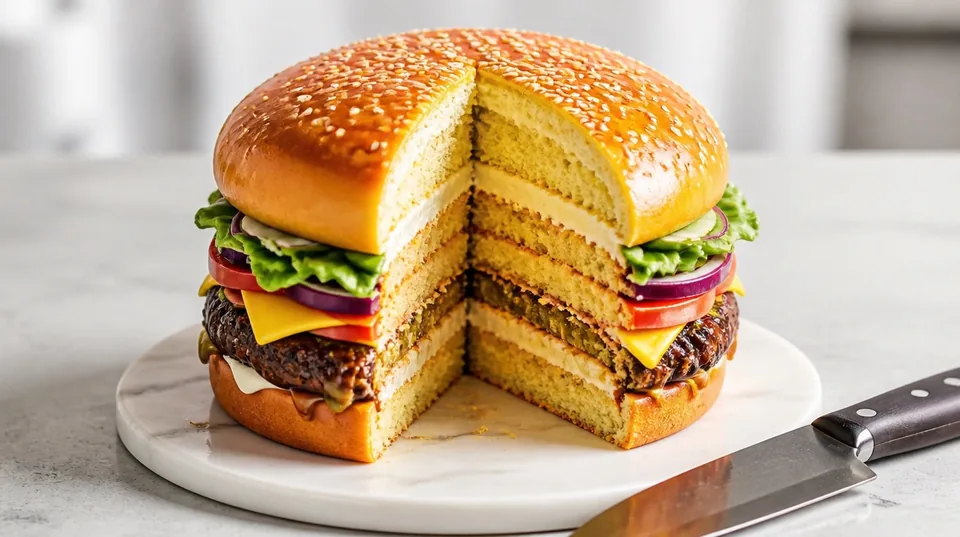
Netflix's Is It Cake is the rare show whose entire premise fits in its title, yet the rules confuse a surprising number of viewers. Who are the judges? How does anyone win money for guessing? And what does the champion actually take home? Here is how the machine works, who has won it, and where the franchise has gone since, with the full season record on our show hub.
The basic format
Each episode, a group of skilled cake artists builds hyper-realistic cakes that replicate an everyday object, anything from a sewing machine to a fire hydrant to a handbag. The bakers get roughly eight hours to bake, carve, and decorate. Then comes the reveal: each cake is hidden in a lineup of five identical-looking real objects, and the judges have just 20 seconds to point at the one they think is cake.
The scoring logic is inverted from a normal baking show. Here, being spotted is bad. If the judges correctly identify your cake, it gets exposed on camera with a dramatic knife cut and you are out of the running for the episode. If your cake fools them, you survive, and the episode's best deceiver takes the round.
Where the format came from
The show's premise closely tracks a recognizable internet trend that predates it: short videos of hyperrealistic cakes shaped like ordinary objects, captioned with some version of "is it a cake?", had already been circulating widely online before Netflix built a full competition series around the same question. Turning an existing online joke into a full production is not a new move for streaming platforms, but Is It Cake? is one of the cleaner examples of the format translating successfully, since the joke itself, guess whether this thing is cake, requires almost no explanation for a first-time viewer.
Who the judges are
This is the part that trips people up: Is It Cake has no permanent judging panel. The judges are rotating celebrity guests, usually comedians and actors, who change from episode to episode. Their job is not to evaluate flavor or technique like a Paul Hollywood; it is simply to guess, badly and entertainingly, which object is cake. The one constant is host Mikey Day, the Saturday Night Live cast member whose running commentary holds the whole thing together, and whose deadpan disbelief sets the tone in place of technical judging. We profile him properly in our Mikey Day explainer.
The money
The winnings come in layers, and the amounts have shifted between seasons.
- Episode wins. In seasons 1 and 2, each episode winner collected $5,000, plus a bonus shot at more by guessing which of two displays of cash was real and which was cake. By season 3, the per-episode prize had grown to $10,000.
- The finale. The episode winners return for a final showdown, and the last baker standing takes a $50,000 grand prize.
Stack a few episode wins on top of the finale and a champion can leave with a serious payday. Season 2 winner Elizabeth Rowe, for example, walked away with $90,000 in total winnings.
Every season and special
| Season | Release | Winner |
|---|---|---|
| Season 1 | March 2022 | Andrew Fuller |
| Season 2 ("Is It Cake, Too?") | June 2023 | Elizabeth Rowe |
| Season 3 ("Is It Cak3?") | March 2024 | Henderson Gonzalez |
| Is It Cake? Holiday | November 2024 | Themed celebrity special |
| Is It Cake? Halloween | October 2025 | Themed special |
| Is It Cake? Valentine's | February 2026 | Themed special |
A fourth full season was announced for the main series after season 3's success, alongside the growing run of holiday-themed specials.
The three champions so far
Season 1: Andrew Fuller
Season 1 premiered on March 18, 2022 and was won by Andrew Fuller of Des Moines, Iowa, the first baker to prove the format could crown a champion on deception alone.
Season 2: Elizabeth Rowe
Season 2 landed on June 30, 2023, and by the end of its finale a Texas baker had quietly out-deceived everyone. Elizabeth Rowe of Lewisville, Texas beat finalists Spirit Wallace and Miko Kaw Hok Uy to become the show's second champion. Her run was defined by realism under pressure, cakes replicating handbags, shoes, and other everyday objects convincingly enough to survive the judges' 20-second inspections. She picked up the nickname "Stitch Queen" for her uncanny edible stitching, the kind of detail work that makes a fondant handbag read as leather on camera. Her total winnings across the season came to $90,000, one of the largest hauls the franchise has paid out.
Unlike winners who used the show to launch a business, Rowe already had one. She owns The London Baker, her bakery in Lewisville, and local coverage after the season, including a profile by Community Impact, documented what a Netflix win does to a small shop: requests for hyper-realistic cakes started pouring in the moment the season dropped. The business has since grown to two Texas locations, the original Lewisville shop and a second in Castle Hills, and she has talked about pointing her winnings at practical things, home repairs and expanding the bakery, rather than anything flashy. Since then she has settled into the mid-sized fame a Netflix baking win brings: Dallas-Fort Worth television spots, podcast appearances, and a steady stream of customers who found her through the show, with her public profile staying tied to the craft rather than a pivot into full-time television. Among the franchise's champions she is the clearest example of the win as accelerant rather than career change.
Season 3: Henderson Gonzalez
Season 3 arrived on March 29, 2024, and its finale came down to three bakers: Henderson Gonzalez, Jujhar Mann, and Timmy Norman. Gonzalez took the title with a toy box cake convincing enough to fool the judges one last time.
His backstory was one of the season's best. Born in Venezuela in 1987, he moved to the United States in 2016 and landed a job at Walt Disney World in Orlando, where he sharpened the cake skills that would eventually carry him onto Netflix. By the time he was cast, he was describing himself as an artistic baker, sugar architect, and 3D cake expert, and the season bore that out: his cakes leaned on architectural structure as much as airbrushing. The toy box showpiece won him the $50,000 grand prize, stacked on top of the $15,000 he had already banked in episode wins during the season. Reports on his total varied slightly depending on how the bonuses were counted, but the verified core is the finale prize plus episode winnings.
Gonzalez has stayed in Florida and stayed on brand. Post-season coverage confirmed he continues to run his cake business in the Orlando area, taking the custom 3D and sculpted commissions that made his name, and he keeps a public portfolio going as @masterbakerfl on Instagram. His footprint since the win has been steady rather than splashy: no network hosting gigs or cookbook announcements have been widely documented, just a working cake artist with a much bigger audience than before.
All three champions converted the win into fuel for a real-world cake business rather than a media career. It has become the franchise's signature outcome: the show finds working cake artists, hands the best deceiver a check, and sends them home to a waiting list.
The specials outgrew the main format
The holiday, Halloween, and Valentine's specials have become nearly as central to the show's identity as the numbered seasons, swapping the standard contestant panel for celebrity judges and leaning harder into spectacle than the original run's more straightforward object-guessing games. That shift toward celebrity-driven specials mirrors a broader trend across competition television, where limited-run holiday episodes often draw viewers who would not commit to a full season but will watch a one-off built around recognizable faces. It has also let the show keep a near-constant release cadence since 2022 rather than the usual yearly gap between seasons most competition shows run on.
Why the format works
Is It Cake is really a magic show wearing a baking show's apron. The craft is genuine, the trompe l'oeil skills on display are elite, but the pleasure is the reveal, the knife sliding through what looked like a leather boot. Part of the appeal is how low the barrier to entry is for viewers: you do not need to know anything about baking technique to play along, which makes it one of the most shareable competition formats Netflix has produced. Viewers are never asked to evaluate whether a bake is good, only whether it is real, and that simplicity is a large part of why the show translates so easily into short clips online.
If you like this, watch these next
Is It Cake? sits in a cluster of Netflix baking-competition shows built around a gimmick rather than a season-long elimination arc, alongside the cake-replication chaos of Nailed It and the team-based sprint format of Sugar Rush. All three have their own season hub on this site; start with the Is It Cake? hub or browse our shows directory to see the rest. For the wider streaming landscape, our roundup of the best baking shows to stream covers where each one fits. If the show has you wanting to attempt a hyperrealistic cake yourself, a set of proper cake decorating tools is the non-negotiable starting point; nobody replicates a sneaker in fondant with a butter knife.
Baking gear
Kit worth having for this
Our tested picks for each, with what to buy at each budget.
More in The Proving Drawer or start with the show guides.